
If you have used ChatGPT, customer-support bots, or AI assistants, you may have noticed a new term appearing everywhere: AI agents. But what exactly makes an AI agent different from a chatbot?
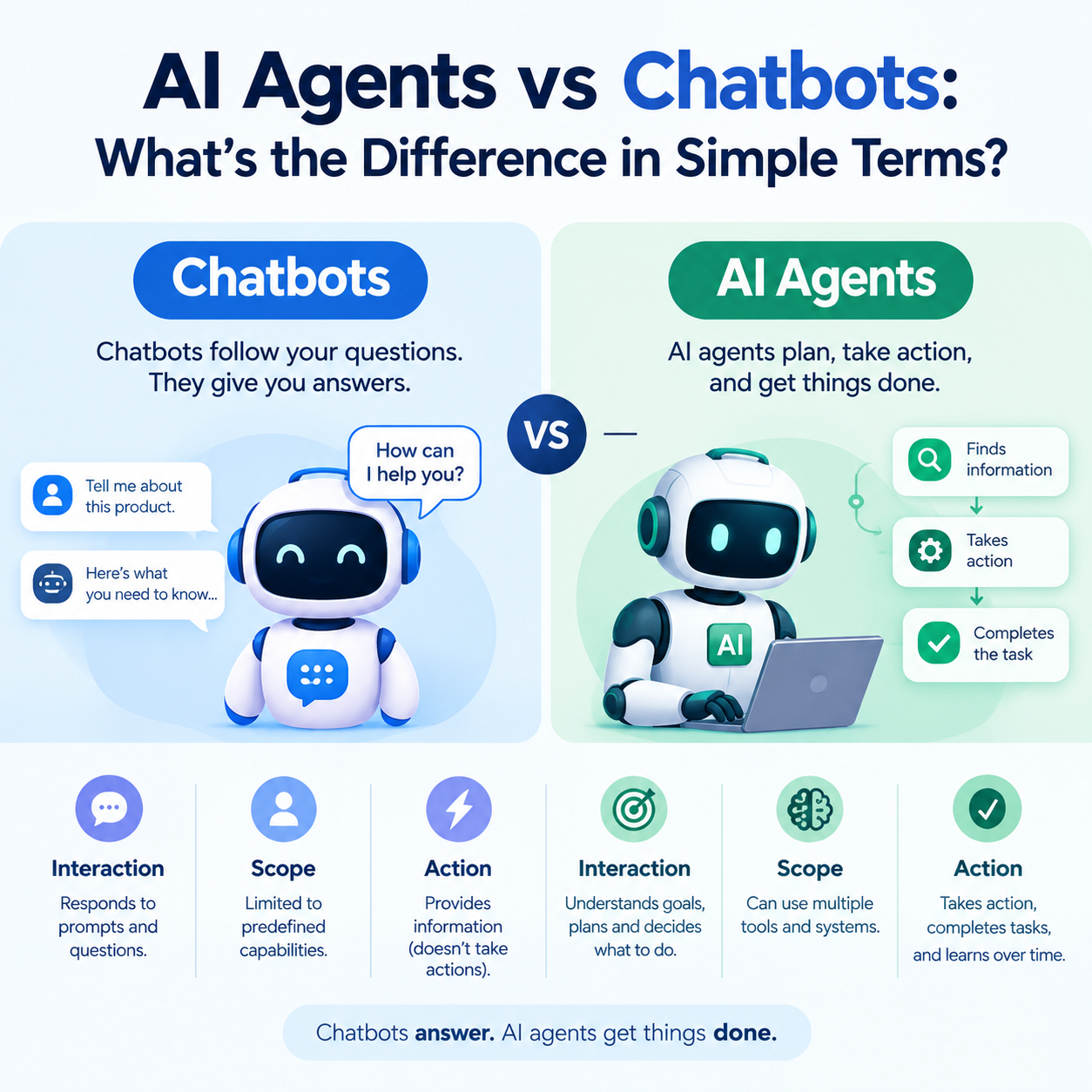
The simplest way to understand AI agents vs chatbots is this: a chatbot mainly responds to you, while an AI agent can work toward a goal by planning steps, using tools, and taking actions. Both can use the same underlying AI models, but the software around the model determines what it can actually do.
That difference matters if you're trying to understand modern AI tools, automation, or what people mean when they talk about “agentic AI.”
What Is an AI Chatbot?
An AI chatbot is software designed to communicate with people using natural language.
You ask a question, give it an instruction, or describe a problem, and it generates a response.
For example:
You: “Explain how a website works.”
Chatbot: “A website consists of several components, including…”
The chatbot's main job is to understand your message and provide a useful response.
Modern AI chatbots can do much more than the old rule-based bots. They can:
Answer questions
Explain complicated topics
Summarize documents
Write emails
Generate ideas
Translate text
Write or explain code
Help troubleshoot problems
Analyze information
How chatbots work
A simplified chatbot interaction looks like this:
User → Message → AI model → Response → User
You remain responsible for deciding what happens next.
For example, you might ask a chatbot:
“Find three laptops suitable for video editing.”
The chatbot could research or provide recommendations, depending on its capabilities. But traditionally, you are still the person who takes the next step—comparing products, visiting websites, and making the purchase.
That's the important distinction.
What Is an AI Agent?
An AI agent is an AI-powered system designed to pursue a goal across multiple steps. It can decide what actions are needed, use available tools, observe the results, and continue working toward the objective. Anthropic describes an agent as a system that directs its own processes and tool use while completing a task.
Instead of simply answering:
“Here is how you can book a flight.”
an agent may be designed to:
Understand your travel requirements
Search available flights
Compare options
Check relevant information
Ask for confirmation when required
Complete an allowed booking action
Provide the result
The key idea is action.
How AI agents work
A simplified agent workflow looks more like:
Goal → Plan → Use tools → Take action → Check result → Continue → Complete
An agent may interact with:
Websites
APIs
Databases
Files
Software applications
Email systems
Calendars
Business systems
Modern agent systems can therefore handle tasks that would otherwise require several separate steps from a human. OpenAI, for example, describes agentic systems as capable of orchestrating tool calls and working on longer-horizon tasks rather than only handling individual conversations.
AI Agents vs Chatbots: The Key Difference
The easiest way to remember the AI agent vs chatbot distinction is:
A chatbot gives you an answer. An AI agent works toward an outcome.
Here's a practical comparison:
This isn't a strict technical boundary. A modern chatbot can have tools, memory, and automation features, while an agent can communicate through a normal chat interface. The important question is what the system is actually designed and authorized to do.
A Simple Real-World Example
Imagine you're running an online store.
A customer asks:
“Where is my order?”
Chatbot approach
The chatbot might:
Ask for the order number.
Look up the information.
Tell the customer the current status.
For example:
“Your order was shipped yesterday and is currently in transit.”
That's useful, but primarily conversational.
AI agent approach
An agent could potentially:
Identify the customer's order.
Check the shipping system.
Investigate a delivery delay.
Contact or query another connected system.
Determine what action is permitted.
Update the customer.
Create a support ticket if necessary.
The difference isn't simply that the agent is “smarter.”
The difference is that the agent is designed to manage a workflow and interact with other systems.
Can AI Agents Take Actions?
Yes, AI agents can take actions when they have access to the appropriate tools, permissions, and systems.
But this doesn't mean every AI agent can freely control your computer or accounts.
An agent might be given access to specific tools such as:
A search API
A CRM
A calendar
An email system
A database
A browser
A code execution environment
For example, an AI agent could be designed to receive:
“Prepare my weekly sales report.”
It might gather information from a database, analyze it, create a report, and send it to an approved destination.
The exact capabilities depend on how the agent has been built and what permissions it has.
Some modern agent systems can interact with websites, run code, access connected applications, and work through multi-step tasks. OpenAI's agent documentation describes this kind of workflow, while Anthropic highlights the additional risks created when agents have more autonomy and tool access.
AI Agent Examples
You don't need to imagine a science-fiction robot to understand an AI agent.
Here are practical AI agent examples:
1. Coding agents
A coding agent can be given a software task and potentially:
Inspect a codebase
Identify relevant files
Write code
Run tests
Read errors
Modify the implementation
Repeat until the task is completed
The important part is that the developer isn't necessarily specifying every individual action.
2. Research agents
A research-oriented agent can potentially:
Search multiple sources
Collect information
Compare findings
Organize evidence
Produce a structured report
3. Customer-service agents
An agent can potentially move beyond answering FAQs and work with connected business systems to resolve specific customer requests.
4. Business automation agents
An agent could monitor incoming information, classify requests, update systems, and escalate situations that require human approval.
These examples demonstrate why AI automation vs chatbot isn't simply about having a more advanced chat interface. Agentic systems are generally focused on completing workflows rather than only generating conversational responses.
Chatbot Examples
Chatbots are still extremely useful.
Common chatbot examples include:
Website support assistants
FAQ bots
AI writing assistants
Educational tutors
Customer-service chat interfaces
Internal company knowledge assistants
General-purpose AI assistants
A chatbot is particularly useful when the desired result is information or communication.
For example:
“Explain this error message.”
“Write a professional email.”
“Summarize this document.”
“What does this technical term mean?”
You don't necessarily need an autonomous agent for these tasks.
AI Agent Use Cases vs AI Chatbot Use Cases
The right choice depends on the job.
AI chatbot use cases
A chatbot is often suitable when you want:
Customer questions answered
Information explained
Content drafted
Documents summarized
Basic troubleshooting
Learning assistance
Conversational support
AI agent use cases
An agent becomes more useful when the task involves:
Multiple steps
External tools
Repeated workflows
Decision-making during execution
Data retrieval and manipulation
Software interaction
Task completion rather than just advice
A useful test is:
Does the user mainly need an answer, or do they need something done?
If they need an answer, a chatbot may be enough.
If they need something done across several systems, an agent may be more appropriate.
Agentic AI vs Chatbot: Are They Completely Different?
Not necessarily.
This is where the terminology can become confusing.
An AI agent can have a chatbot-style interface.
In fact, you could interact with an agent through a normal chat window:
“Find the information I need, organize it into a report, and save the report.”
The interface looks like a chatbot.
Underneath, however, the system may be planning tasks, calling tools, checking results, and continuing until it reaches the requested outcome.
So agentic AI vs chatbot isn't necessarily a comparison between two different-looking apps.
It's more about how the AI operates behind the interface.
Common Mistakes Beginners Make
Mistake 1: Assuming every AI chatbot is an agent
Adding a chat window to an application doesn't automatically make it an AI agent.
Mistake 2: Assuming agents are always autonomous
Agents can have different levels of autonomy. A system may require approval before performing important actions.
Mistake 3: Thinking agents don't need humans
Human oversight can remain important, particularly when an agent has access to sensitive information or systems.
Mistake 4: Assuming agents are always better
More autonomy isn't automatically better.
If you only need an explanation, an agent may add unnecessary complexity.
A simple chatbot can be easier to understand, control, test, and maintain.
Mistake 5: Giving an agent too many permissions
The more systems an agent can access, the greater the consequences of mistakes or unexpected behavior. Anthropic specifically notes risks such as unintended actions and prompt-injection attacks as agent autonomy and tool access increase.
So, Which One Should You Use?
Think about the task first.
Choose a chatbot when:
You primarily need information.
A human will make the final decision.
The task is mostly conversational.
You don't need multiple external systems.
You want a simple AI assistant.
Consider an AI agent when:
You want a task completed rather than merely explained.
The task contains multiple steps.
The AI needs to use external tools.
The workflow happens repeatedly.
The system needs to respond to changing information during execution.
The goal isn't to replace every chatbot with an agent.
It's to use the least complicated system that can reliably complete the job.
AI Agents Explained in One Example
Here's perhaps the easiest mental model:
Chatbot:
“Tell me how to create a monthly sales report.”
Chatbot → explains the process.
AI agent:
“Create my monthly sales report.”
Agent → collects the required data → analyzes it → creates the report → checks the result → delivers it.
That's the difference between answering a task and working toward completing a task.
What Beginners Should Remember About AI Agents
If you're just starting to explore AI, remember these five points:
A chatbot is mainly built for interaction.
An AI agent is built to pursue a goal.
Agents can use tools and external systems.
Not every task needs an agent.
More autonomy also means more need for permissions, monitoring, and human oversight.
The technology is also moving quickly. In 2026, major AI companies are increasingly presenting agents as systems for longer, multi-step work rather than only question-and-answer interactions.
Frequently Asked Questions
1. What is the difference between AI agents and chatbots?
The main difference is their role. A chatbot primarily responds to user messages, while an AI agent can pursue a goal across multiple steps, use tools, and take actions within the systems it has been given access to.
2. Can an AI chatbot become an AI agent?
Yes. A conversational AI system can be connected to tools, APIs, memory, workflows, and action capabilities. At that point, it may function as an agent depending on how independently it can plan and execute tasks.
3. Can AI agents take actions?
Yes. AI agents can take actions when they have the required tools and permissions. Depending on the system, this could include searching information, modifying files, interacting with software, or performing approved operations.
4. Are AI agents better than chatbots?
Neither is automatically better. Chatbots can be appropriate for questions, explanations, and conversations, while agents are more suitable for certain multi-step workflows and automation tasks.
5. What are some examples of AI agents for beginners?
Beginner-friendly examples include coding agents, research agents, customer-support automation agents, scheduling assistants, and business workflow agents. Their capabilities depend on the tools and permissions provided to them.
Conclusion
The easiest way to understand AI agents vs chatbots is to focus on the outcome.
A chatbot is generally designed to talk with you and provide a response.
An AI agent is designed to work toward a goal, potentially using tools and taking actions along the way.
That doesn't make chatbots outdated. In many situations, a straightforward conversational assistant is exactly what you need. Agents become useful when the problem goes beyond conversation and involves a workflow that needs to be executed.
As AI systems become more capable, the line between chat interfaces and action-oriented systems will continue to become less obvious. For beginners, however, one question makes the difference much easier to understand:
“Do I want AI to tell me how to do something, or do I want AI to help actually do it?”